Kitchen Purchase Desk — Workload-first equipment comparisons without sales pressure
Comparison Method Buying Answers
Cookware Specification Guide

Cookware for Daily Demands

When a pan fails in a working kitchen, it rarely fails dramatically—it bows slightly in the centre so oil pools around the perimeter, or its handle loosens just enough to twist when a cook flips a 2 kg reduction. Selecting cookware that survives five years of double shifts means looking past mirror finishes and focusing on metal alloy, millimetre gauge, base bonding, and vessel geometry.

Thermal Physics on the Line

Conductivity vs. Heat Capacity

Every kitchen buyer has to balance two competing physical traits: thermal diffusivity (how quickly heat spreads across the pan floor without hotspots) and volumetric heat capacity (how much thermal energy the metal stores when a cold protein hits the surface).

Bare 3003 commercial aluminium conducts heat roughly fifteen times faster than 304 stainless steel. That makes thick-walled aluminium unbeatable for rapid pasta tosses, emulsions, and high-turn sauté stations where the burner flame is adjusted constantly. However, aluminium has low density, meaning a cold ribeye will drop its surface temperature unless the wall gauge is at least 4.5 mm to 6.0 mm thick.

Carbon steel and cast iron flip that equation: they heat more slowly and unevenly over ring flames, so they benefit from gradual preheating, but once hot they store dense thermal energy that sears crusts cleanly without steaming the food.
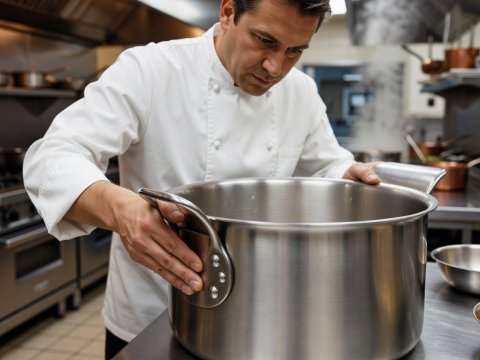
Chef inspecting heavy triple rivets and flared pouring rim on a stainless steel rondeau brazing pot

Why Vessel Shape Dictates Evaporation

A tall, narrow stockpot minimizes surface area so bone broths simmer for twelve hours without boiling dry. A wide, low-sided rondeau (brazier) maximizes surface area to sear twenty chicken thighs in a single layer and reduce jus in minutes.

Commercial Cookware Alloy & Gauge Comparison

Use this specification table to match vessel materials to your burners, acidic recipes, and dish pit routines.

Material / Construction Recommended Gauge Induction Compatible Acid Reactivity Best Station Workload
3003 Heavy Aluminium 4.0 mm – 6.0 mm (6 to 4 gauge) No (unless bonded steel plate added) High — pits and discolours with wine, tomato, lemon High-turn pasta pick-ups, blanching, neutral oil sautéing
Impact-Bonded Disc Stainless 0.8 mm – 1.2 mm walls; 5.0 mm core disc Yes (with 430 ferritic outer base) Non-reactive (304 / 18/8 interior) Stockpots, bain-maries, induction soup & boiling stations
Fully Clad Tri-Ply Stainless 2.6 mm – 3.2 mm total wall & base Yes (magnetic stainless exterior) Non-reactive across entire interior Sauciers, pan reductions, gas flames that lick up pan sidewalls
Blue / Black Carbon Steel 2.0 mm – 3.0 mm spun or pressed Yes (high magnetic permeability, warp risk if thin) Moderate — strips seasoning if simmered with acid Protein searing, eggs, high-heat oven-to-burner roasting
PTFE Reinforced Non-Stick 3.5 mm – 4.5 mm aluminium body Varies by base plate Non-reactive until coating scratches Breakfast egg service, delicate skinless fish, crepes below 230°C

Sheet Pans & Roasting Trays: The 18-Gauge Rule

Nothing reveals false economy faster than bargain bun pans. A 20-gauge or 22-gauge aluminium sheet pan pops and twists diagonally the moment it moves from a walk-in retarder into a 220°C convection oven, causing melted fats and cake batters to run into one corner.

Rim Wire Engineering

Galvanised vs. Stainless Bead Wire

Commercial 18x26 inch (457x660 mm) full-size and 18x13 inch half-size sheet pans rely on a steel wire rolled inside the top rim to resist twisting when lifted by one corner with tongs. Always specify 16-gauge or 18-gauge 3003 aluminium with a fully closed bead or rust-proof wire. If you wash sheet pans in high-temp chemical machines, punctured rims allow caustic water to corrode cheap carbon wire from the inside out, dripping brown rust streaks onto pastry parchment.

Perforated vs. Solid

Airflow in Combination Ovens

Solid pans retain roasting juices for pan gravies and braises. Perforated sheet pans—punched with 3 mm holes across the floor—increase convective air contact by 35%, cutting par-bake times on baguettes and crisping roasted root vegetables without flipping mid-cycle.

Material Trade-Offs: Disc-Bottom vs. Fully Clad

Sales reps often push fully clad 3-ply or 5-ply cookware across an entire kitchen order. In practice, paying for clad sidewalls on a 40-litre stockpot wastes budget and adds unnecessary lifting weight.

  • When Disc-Bottom Wins: In tall stockpots and pasta cookers filled with liquid, convection currents carry heat upward from the floor. An impact-bonded 5 mm or 6 mm aluminium disc sandwiched onto a 1.0 mm stainless body delivers flat, warp-free induction contact at half the price and 25% less weight than full cladding.
  • When Fully Clad Wins: In sloped-side sauciers, fry pans, and rondeaux used over wide gas burners, flames wrap up the exterior curve. On a disc-bottom pan, the transition seam where the thick base meets the thin sidewall creates a scorching "ring of fire" that burns cream reductions and fond. Full tri-ply construction distributes heat evenly right up to the pouring lip.
  • Riveted vs. Spot-Welded Handles: Heavy tubular stainless handles attached with three large-head rivets are mechanically bombproof—even if a rivet loosens after years of thermal cycling, the handle cannot detach while carrying boiling stock. However, rivets create interior bosses that interrupt whisking in a saucier. Multi-point sanitary spot welds leave a totally smooth interior wall for pastry creams and roux, provided you buy from manufacturers using thick backing plates.

Care & Maintenance Accordions

Preventing thermal warp on high-output induction units

Commercial 3.5 kW and 5.0 kW induction hobs induce intense eddy currents in the bottom millimetre of magnetic steel before heat can conduct into the upper pan walls. Never preheat an empty carbon steel or thin disc pan on 100% boost power; step up from 50% power over forty-five seconds, and never plunge a screaming-hot dry skillet straight into cold pot-sink water.

Restoring pitted or blackened aluminium sauté pans

Never run bare aluminium through a commercial dishwasher using high-pH caustic detergent—it turns the metal chalky grey-black that rubs off on white sauces and towels. Clean bare aluminium in the three-compartment sink with neutral dish soap and green scouring pads. Boil a mild solution of water and cream of tartar (15 g per litre) for ten minutes to brighten dull oxidised interiors.

Seasoning blue carbon steel for Day-One service

New carbon steel ships with a protective beeswax or machine-oil coating. Scrub it thoroughly in very hot soapy water using steel wool until bare metal shows. Dry over a burner, wipe a micro-thin film of high-smoke-point oil (grapeseed or refined canola) using a lint-free towel until the pan looks dry, and heat until smoking turns the steel bronze-blue. Repeat twice before service.

Set your buying criteria